· ReadyStack
Worked example
Real numbers from this tool, line by line.
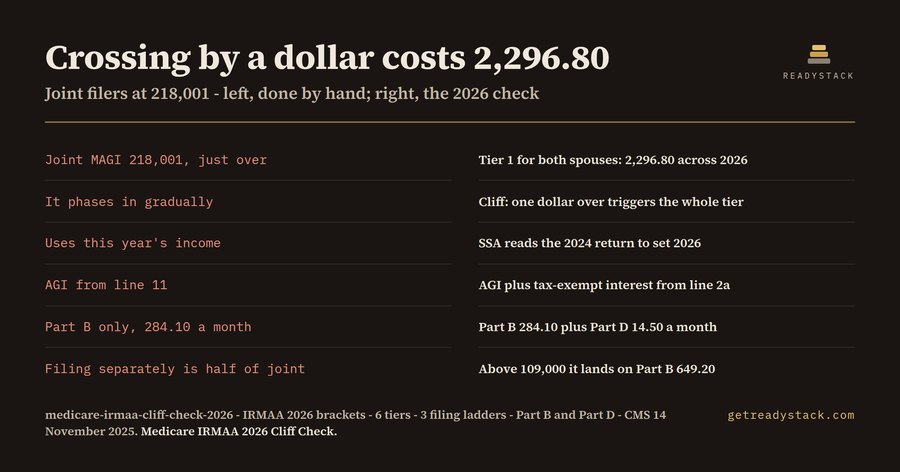
A retired couple who put 218,001 dollars of modified AGI on their 2024 tax return will pay 2,296.80 more for Medicare across 2026 than the couple who put 218,000. One dollar of income, and the whole surcharge tier lands for twelve months.
That is what IRMAA - the income-related monthly adjustment amount - does. It is a cliff, not a phase-in. Social Security looks back two years, so the 2024 return sets the 2026 premium, and there is no proration for landing barely over a threshold.
The 2026 numbers were announced by CMS on 14 November 2025. The standard Part B premium is 202.90 a month. Above the first threshold - 109,000 for a single filer, 218,000 for a joint return - Part B goes to 284.10, then 405.80, 527.50, 649.20 and 689.90 at the top. A Part D adjustment rides on the same ladder: 14.50, 37.50, 60.40, 83.30 and 91.00 a month, billed even when the drug coverage sits inside a Medicare Advantage plan.
Put those together for two people and the first step is 2,296.80 for the 2026 year. The second and third steps are larger: 3,472.80 to go from the first tier to the second. A couple at the top of the table pays 13,872 a year above the standard premium.
Three things go wrong when people check this themselves.
The first is the year. Every threshold and every premium is reset annually, so a bracket page written last autumn, or a chat answer trained on it, returns 2025 figures that are all different from the ones Social Security will use.
The second is the definition. Social Security does not use AGI. It uses AGI from Form 1040 line 11 plus tax-exempt interest from line 2a. Municipal bond interest is exactly the income a retiree is most likely to hold and least likely to count, and it is exactly what moves a return across a line the taxpayer thought was comfortably ahead.
The third is Part D. Most free tables price Part B and stop. The Part D adjustment adds up to 91.00 a month per person.
Married filing separately deserves its own warning. That status does not get half of the joint ladder. Above 109,000 it goes straight to the 649.20 Part B rate with an 83.30 Part D adjustment - 6,355.20 a year for one person - and to 689.90 and 91.00 above 391,000.
This is why the check belongs in the browser, in the room where the number is still moveable: sizing a Roth conversion in December, deciding whether a capital gain falls this year or next, timing the sale of a rental, or reading the determination letter that arrives from Social Security in the autumn and deciding whether to challenge it.
The Medicare IRMAA 2026 Cliff Check is a small extension that does exactly that. Enter the filing status, the MAGI on the return Social Security will read, any income still under consideration, how many people in the household are on Medicare, and whether there is drug coverage. It returns the 2026 tier, the next threshold in dollars, how many dollars of room are left before it, and what crossing it costs the household for the year.
A single filer at 140,000 with drug coverage: tier 2, 2,884.80 for the year, 31,000 of room before the 171,000 line. Change nothing but the filing status to separate at 200,000 and the answer becomes 6,355.20.
Every calculation is free and unlimited - all six tiers, all three ladders, no key, no trial count, nothing leaving the browser. The paid tier is on a different axis: keeping the work (a .csv of every scenario, for the tax file) and repeating it (an alarm before a Form SSA-44 filing or the 31 December cut-off). A fee-only planner bills 250 to 400 dollars an hour for the same conversation.
15 seconds — what it actually does
Full walk-through
Questions people ask
What does the IRMAA cliff check actually do?
You type the MAGI from the tax return Social Security will read, plus any income you are still deciding to take. It returns your 2026 IRMAA tier, how many dollars are left before the next threshold, and what crossing that threshold costs your household for the whole year in Part B and Part D.
Who is this for?
US retirees and near-retirees on Medicare, and the adult child or spouse who prepares the return. It is built for the moment you size a Roth conversion, sell a rental, or take a large RMD in December and need to know which side of the line the result lands on.
Why not just ask a chatbot or use a free bracket page?
The thresholds and premiums change every year, so free pages and chat answers still quote 2025 numbers. They also price Part B only and use AGI, while Social Security adds tax-exempt interest from line 2a. Both mistakes move you a tier without you noticing.
What is free and what needs the key?
Every calculation is free and unlimited: all six 2026 tiers, all three filing statuses, Part B and Part D, one or two people. The 60 dollar key adds two things on a different axis - a .csv export of the scenarios you ran, and an alarm set before a date you choose.
What would this cost done by a person?
A fee-only financial planner bills roughly 250 to 400 dollars an hour, and IRMAA bracket work is normally part of a paid year-end planning session. Crossing the first joint threshold by one dollar costs a two-person household 2,296.80 over 2026, which is more than either.
Ask about this tool
One question, answered by the person who built it. Your email only if you want the answer sent.